

Buying an engagement ring is one of the most meaningful jewellery purchases you will ever make. But in 2026, choosing the right diamond can also be surprisingly complicated.
Natural diamonds, lab-grown diamonds and moissanites are all widely marketed as engagement-ring options, yet even though they look similar, they are very different products. Their origins, rarity, pricing, durability, long-term appeal and resale markets vary significantly.
So, how much should you spend on an engagement ring? Is a lab-grown diamond really the same as a natural diamond? Is moissanite a good alternative? And if you are looking for reputable diamond dealers in the Western Cape, how do you know what to look for?
At Mark Solomon Jewellers in Sea Point, we believe something about a natural diamond is irreplaceable.
Mark Solomon Jewellers works exclusively with natural diamonds. For us, this is not simply a matter of tradition. It reflects the value we place on rarity, origin, craftsmanship, and the extraordinary story of a diamond formed naturally over billions of years.
That does not mean lab-grown diamonds and moissanite should be ignored. They have their own advantages, particularly when price and size are the main considerations. But understanding the differences is essential before making such an important purchase. Here is what you need to know about engagement-ring prices and diamond choices in 2026.
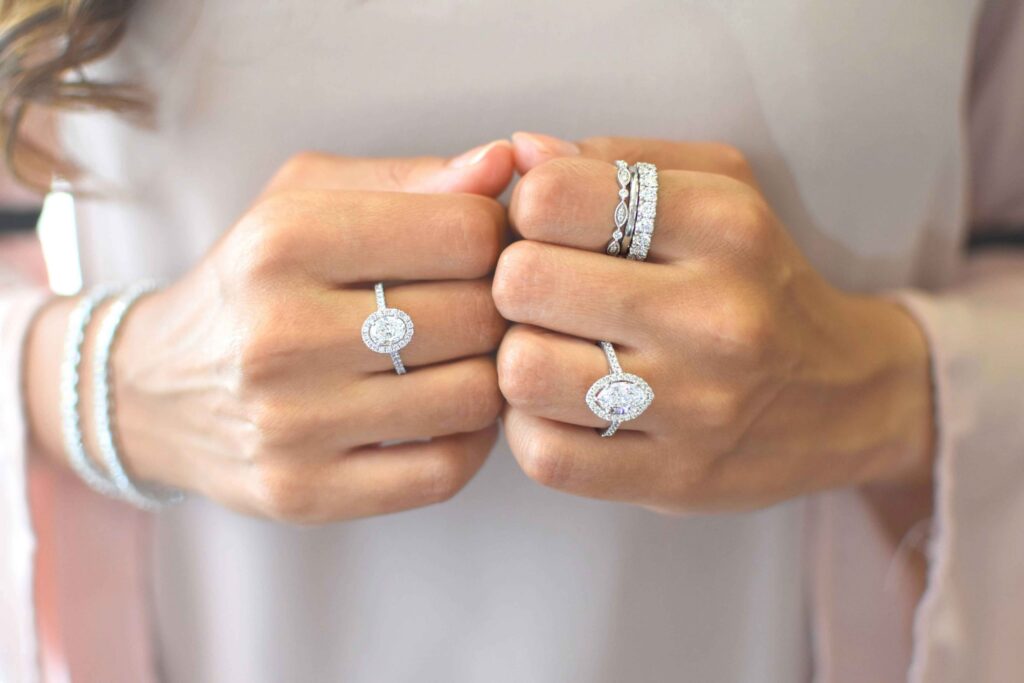
Engagement Ring Prices in South Africa in 2026
The price of an engagement ring can vary dramatically depending on the centre stone, its quality, the metal, the setting and the craftsmanship.
Here is a general 2026 market guide:
| Natural Diamond | Lab-Grown Diamond | Moissanite | |
| Indicative ring starting price | From approximately R30,000 + | From approximately R18,000 + | From approximately R12,000 + |
| Typical 1ct market position | Often R85,000 +, depending on quality | Often around R8,000 + | Often around R2,000 + |
| Hardness | 10 Mohs | 10 Mohs | 9.5 Mohs |
| Is it a diamond? | Yes | Yes | No |
| Origin | Naturally formed underground | Created in a laboratory | Lab-created gemstone |
| Rarity | Naturally rare | Manufactured and scalable | Manufactured gemstone |
| Resale market | Generally medium to high | Generally limited | Limited |
| Main appeal | Rarity, heritage, natural origin and enduring value | Size and lower upfront price | Affordability and brilliance |
These figures are indicative rather than fixed prices. Diamond pricing depends heavily on the individual stone’s specifications.
That distinction is particularly important when comparing natural and lab-grown diamonds.
A one-carat natural diamond and a one-carat lab-grown diamond may have similar measurements, and both may be diamonds, but they do not have the same rarity or market characteristics
Why Natural Diamonds Remain the Ultimate Choice
There is a reason natural diamonds have been associated with engagement rings for generations. A natural diamond is not manufactured to meet demand. It is created by nature under extraordinary conditions deep within the Earth and can take billions of years to form. That makes every natural diamond inherently unique.
When you purchase one, you are not simply buying a stone that has been produced to a specification. You are acquiring a naturally occurring gemstone with its own geological history. At Mark Solomon Jewellers, that distinction matters. We believe an engagement ring should have a sense of permanence and authenticity. The diamond should be something that can be worn today, treasured throughout a marriage and potentially passed down to the next generation.
That combination of rarity, endurance and story is one of the reasons natural diamonds continue to hold such a special place in fine jewellery.

Natural Diamond Prices in 2026
Natural diamonds are generally more expensive than their laboratory-grown counterparts, but that price difference reflects more than simply the appearance of the stone.
For example, a South African 2026 market analysis places a 1 carat natural diamond around the R70,000 – R140,000 plus range depending on colour, clarity and cut, while higher quality stones can move substantially beyond this.
A finished engagement ring can cost considerably more once the setting, metal, craftsmanship and design are included.
This is why there is no meaningful answer to the question:
“How much does a 1 carat diamond cost?”
The better question is:
“How much does a 1 carat diamond with this specific cut, colour, clarity and certification cost?”
Two diamonds with identical carat weights can have dramatically different prices.
The Four Cs Still Matter
When comparing natural diamonds, understanding the 4Cs — Cut, Colour, Clarity and Carat — is essential.
Cut – Cut is one of the most important factors in a diamond’s beauty, influencing how brilliantly it reflects light and sparkles.
Colour – Diamond colour refers to how much natural colour is visible in a stone. Generally, diamonds with less visible colour are more sought after and can command higher prices.
Clarity – Clarity refers to inclusions and blemishes within or on the diamond. Importantly, you do not necessarily need the highest clarity grade to have a beautiful diamond. Some inclusions may be invisible to the naked eye.
Carat – Carat measures weight, not beauty. A larger diamond is not automatically a better diamond. This is where expert advice becomes particularly valuable. Instead of simply chasing the highest carat weight within your budget, a knowledgeable jeweller can help you find the right balance between size and overall beauty.
The Importance of GIA Certification
When buying a natural diamond, certification gives you confidence in what you are purchasing.
The Gemological Institute of America (GIA) is one of the world’s leading gemmological institutions. A GIA diamond report independently assesses key details such as carat, colour, clarity and cut.
At Mark Solomon Jewellers, many of our natural diamonds are GIA-certified. Mark Solomon himself studied gemmology at the GIA in America, giving him specialist knowledge and experience in selecting and evaluating diamonds.
If you are searching for GIA-certified diamonds in Sea Point, this expertise allows you to compare diamonds confidently and understand exactly what you are buying.

Lab-Grown Diamonds: Why Are They Cheaper?
Lab-grown diamonds have recently become one of the biggest changes in the diamond industry.
They are genuine diamonds in the sense that they have the fundamental chemical and physical characteristics of a diamond. However, instead of being formed naturally, they are produced using technological processes such as CVD (Chemical Vapour Deposition) or HPHT (High-Pressure High-Temperature).
The biggest difference for consumers is often price.
Lab-grown diamonds can cost substantially less than natural diamonds of comparable specifications. Depending on the stone, the difference can be dramatic. That can make them appealing to buyers who want a larger diamond without spending as much.
However, price is only one measure of value. Because lab-grown diamonds can be produced repeatedly and at increasing scale, they do not have the same natural scarcity as mined diamonds. This distinction is central to Mark Solomon Jewellers’ approach.
We choose to work with natural diamonds because we believe natural rarity is part of what makes a diamond special.
Lab-Grown Diamond: Pros & Cons
Pros
- Genuine diamond material.
- Excellent durability.
- 10 on the Mohs hardness scale.
- Generally, much less expensive than a comparable natural diamond.
- Allows buyers to consider larger stones within a fixed budget.
- Available in a wide variety of shapes and specifications.
Cons
- Not naturally formed.
- Not naturally rare.
- Resale values are low compared with original retail prices.
- Increasing production can place downward pressure on prices.
- Does not carry the same history as a natural diamond.
What About Moissanite?
Moissanite is another popular engagement-ring alternative. But there is an important distinction: moissanite is not a diamond. It is a different gemstone with its own chemical and optical properties.
Moissanite is extremely durable, approximately 9.25 on the Mohs scale, and is famous for its brilliance and noticeable flashes of colour.
Its biggest advantage is price. A buyer with a limited budget can choose a relatively large moissanite while spending significantly less than they would on a natural diamond. For someone whose primary goal is size and sparkle, that can be attractive. But if what you want is the rarity, natural origin and enduring story of a diamond, moissanite is a fundamentally different choice.
Moissanite: Pros & Cons
Pros
- Significantly less expensive than natural diamonds.
- Excellent durability for everyday wear.
- High brilliance.
- Available in larger sizes at relatively low prices.
- Can create an impressive engagement ring design on a smaller budget.
Cons
- It is not a diamond.
- Has different optical characteristics.
- Has a very limited resale market.
- Is not rare or special.
- Its visual appearance can differ noticeably from a diamond, particularly because of its distinctive fire.

Natural Diamond vs Lab-Grown vs Moissanite: What Are You Really Buying?
This is perhaps the most useful way to look at the comparison.
With a natural diamond, you are paying for a combination of:
beauty + rarity + natural origin + craftsmanship + history.
With a lab-grown diamond, you are primarily getting:
diamond material + beauty + size + lower upfront cost.
With moissanite, you are buying:
brilliance + durability + size + affordability.
None of these descriptions is inherently negative. But they are different propositions.
And when you are buying an engagement ring that you may wear for decades, the question is not simply:
Which stone is cheapest?
It is:
What do I want this ring to represent?
What About Resale Value?
While an engagement ring should be bought because you love it, long-term value is still worth considering.
Natural diamonds have an important advantage: they are established in the global market. This gives them a much stronger position in the resale market than lab-grown diamonds or moissanite.
Lab-grown diamonds can be produced repeatedly and without limits, which has contributed to falling market prices and will affect their long-term resale value. Moissanite, meanwhile, is a different gemstone with a much more limited resale market.
When considering heirloom value, natural diamonds are by far the better choice.
Why Buying From an Experienced Diamond Jeweller Matters
The diamond itself is only part of the purchase. The person helping you select it matters too. When comparing diamond dealers in Cape Town or looking for a trusted diamond jeweller in the Western Cape, consider whether the jeweller can:
- Explain the 4Cs clearly.
- Show you multiple diamonds to compare.
- Provide appropriate certification.
- Explain exactly what you are purchasing.
- Discuss proportions rather than simply carat weight.
- Help you select a suitable setting.
- Offer professional jewellery design.
- Provide after-sales service.
- Explain maintenance and resizing.
- Work within your actual budget.
At Mark Solomon Jewellers, customers can view loose natural diamonds and work with experienced designers and master goldsmiths to create a ring around the stone they choose.
This means the process does not have to begin with a catalogue. It can begin with a conversation.
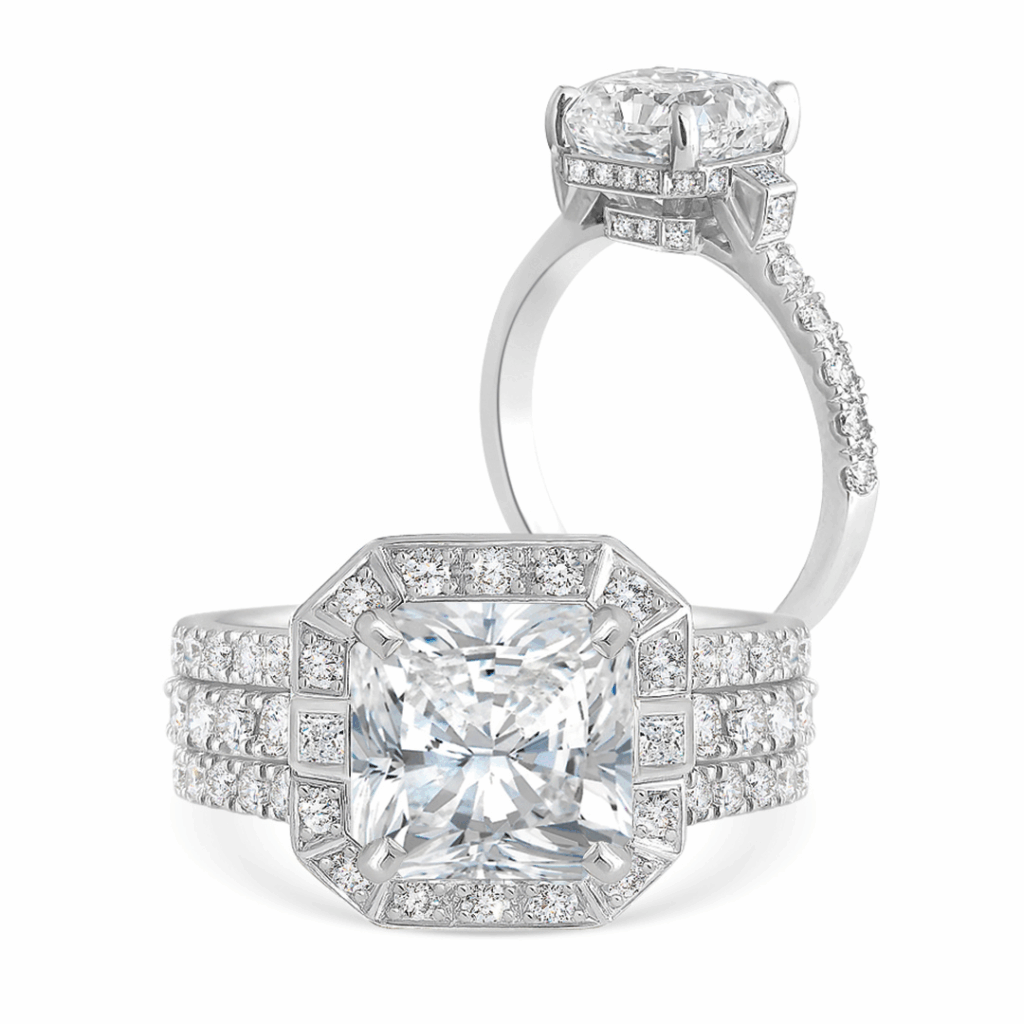
A magnificent cushion-cut diamond engagement ring framed by a detachable geometric pavé halo.
Why Custom Engagement Rings Make Sense
Your engagement ring should be personal. That’s why we believe designing a custom engagement ring is one of the most special experiences you can go through. It allows you to create a ring that not only feels right but also reflects your style and what matters most to you.
At Mark Solomon Jewellers, we have our own Cape Town workshop, award-winning designers and master goldsmiths who will help bring your custom engagement ring to life. This also means your budget can be allocated strategically. For example, you may prefer to spend more on the quality of the natural diamond while keeping the setting understated.
Alternatively, you might choose a simpler diamond and invest more in an intricate setting. There is no right or wrong way to do it, and at Mark Solomon Jewellers there is no limit to your creativity and vision.
A Smart Checklist Before Buying Your Engagement Ring
Before committing to a diamond, ask:
About the stone
- Is it natural, lab-grown, or a simulant?
- What is the carat weight?
- What are the colour and clarity grades?
- What is the cut grade?
- What are the measurements?
- Is there fluorescence?
- Is it independently certified?
About the certificate
- Which laboratory issued it?
- Can the report be verified?
- Does the report correspond with the stone?
About the ring
- What metal is being used?
- How is the diamond secured?
- Is the design suitable for everyday wear?
- Can the ring be resized?
- What after-sales service is included?
About the jeweller
- Can you compare several stones?
- Can they explain the differences?
- Do they have qualified gemmological expertise?
- Do they offer custom design?
- Do they have their own manufacturing capabilities?
If a jeweller is happy to answer these questions, you are already having a much more informed buying experience.

Why Mark Solomon Jewellers Chooses Natural Diamonds
Ultimately, the natural diamond vs lab-grown debate comes down to what you believe makes a diamond valuable.
At Mark Solomon Jewellers, we believe nature cannot be replicated. A natural diamond has existed for an extraordinary length of time before it ever reaches a jewellery showroom. It has been shaped by geological forces that cannot simply be reproduced in a manufacturing process.
That story matters.
This is why Mark Solomon Jewellers works exclusively with natural diamonds. Our approach is not about telling every customer how much they should spend. It is about helping each person understand the diamond they are buying and finding the right balance of beauty, quality, rarity and budget.
For those looking for trusted diamond dealers in the Western Cape or specifically searching for GIA-certified diamonds in Sea Point, Mark Solomon Jewellers offers an experienced, personal approach to diamond selection and custom jewellery design.
The Bottom Line
In 2026, there are more engagement ring choices than ever. Lab-grown diamonds offer genuine diamond material at a significantly lower price and can provide impressive size for the budget.
Moissanite offers exceptional brilliance and durability at an even lower price, but it is a different gemstone altogether. Natural diamonds remain the choice for those who value rarity, history, tradition and the possibility of creating a genuine heirloom.
At Mark Solomon Jewellers, we believe these qualities are not incidental; they are part of what makes a diamond meaningful. The best engagement ring is not necessarily the largest one or the most expensive one, but it is the one you understand, love and will be proud to wear for years to come.
And if you believe that the story behind the stone matters just as much as the sparkle, a natural diamond is a choice that can last far beyond the proposal.
Visit Mark Solomon Jewellers in Sea Point
Mark Solomon Jewellers is located at 373A Main Road, Sea Point, Cape Town.
With an extensive selection of natural diamonds, GIA-qualified gemmological expertise, experienced designers and master goldsmiths, the team can guide you through the process of selecting a diamond and creating an engagement ring that is uniquely yours.
Whether you already know exactly what you want or you are starting with nothing more than a budget and a dream, the first step is simply to compare your options and ask questions.
Because when it comes to an engagement ring, the diamond should be as extraordinary as the story itself.


