
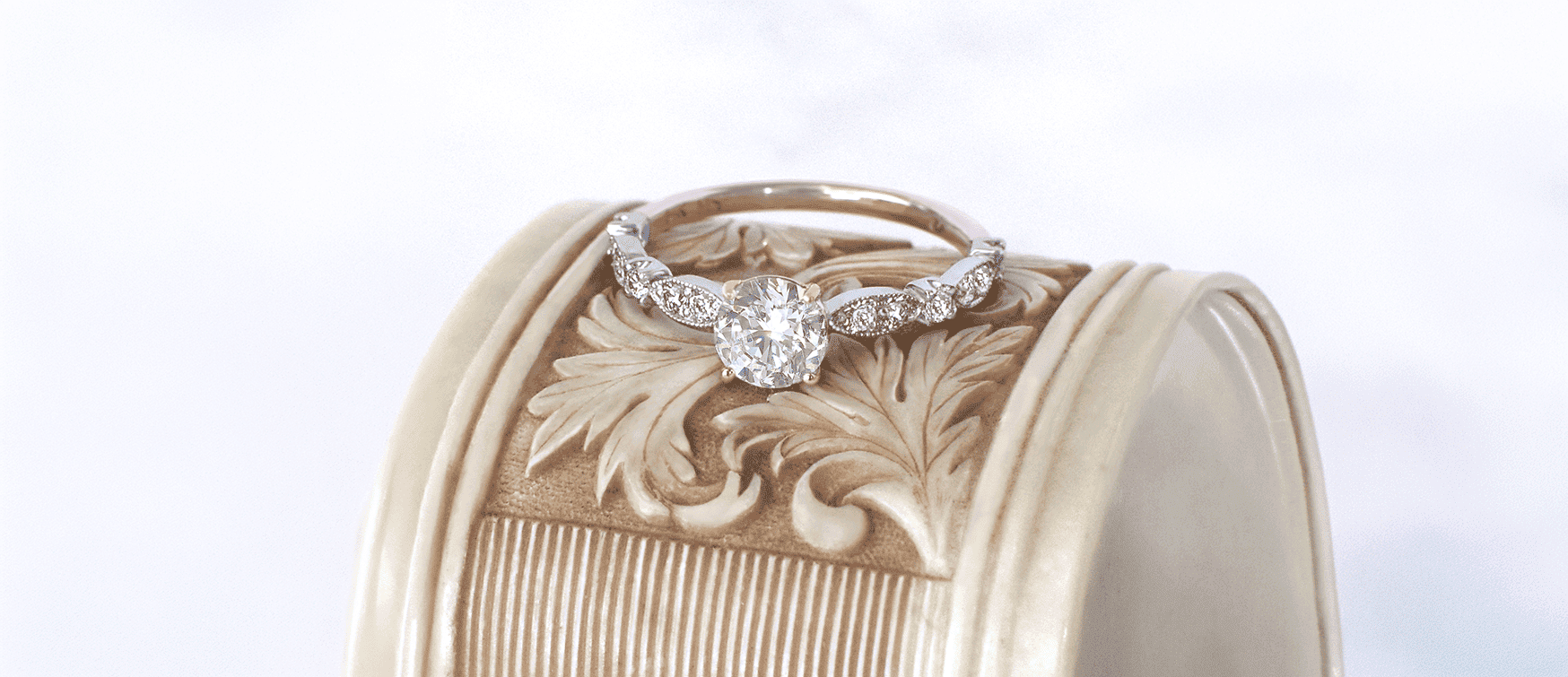
As with any big purchase, shopping for the perfect engagement ring is about finding an option you love at a price you are happy with. As the bulk of an engagement ring’s value most often lies in its centre diamond, this is the ideal place to start. However, diamonds come in such a multitude of grading options, each with its own characteristics and, of course, price tag, that many shoppers dread making the final call. Let’s cut out the nitty-gritty and look at what diamond grading means to you.
When the search for the perfect diamond starts, buyers inevitably learn the four C’s of diamond grading, namely cut, clarity, colour and carat weight. The international pricing structure of diamonds, called the Rapaport, assigns a per-carat price for each size range of diamonds based on a particular colour and clarity combination. This structure, in turn, is divided into round brilliant cut diamonds and fancy cuts (every cut besides round brilliant).
Carat Weight
Arguably, the simplest grading to understand, the carat weight of a diamond, by nature, indicates its size. For your interest, the 1 carat equates to exactly 0.20 grams. A well-cut 1.00ct round brilliant cut diamond measures approximately 6.50mm in diameter. Since the angles of a diamond have to fall within an ideal range to facilitate optimal refraction (sparkle), a 1.00ct stone with an unusually large or small diameter indicates a poor cut quality. For this reason, diamonds grow in every dimension as they increase in carat weight, so a 2.00ct would not have double the diameter of a 1.00ct. The ideal 2.00ct round brilliant cut diamond has an optimal diameter of approximately 8.00mm.
Due to the rarity of larger, gem-quality diamonds, prices become exponentially higher per carat as the weight of a single stone increases. 10 diamonds with a total weight of 1.00 carats would therefore be a fraction of the price of an equivalent quality single stone with this weight.
Clarity
While a diamond’s cut determines how light refracts, extreme clarity flaws (such as dense internal clouds or heavy graining) can obstruct light transmission and diminish brilliance. However, for high-to-medium clarity grades, inclusions are too small to affect light dispersion, meaning an eye-clean VS or SI diamond will sparkle just as brightly as a Flawless stone. Diamond clarity refers to the presence, or absence, of natural imperfections in a particular stone. These can be internal or on the surface of a diamond and range from almost undetectable irregularities in the crystal structure to highly visible black areas within an otherwise transparent stone.
While an IF (Internally Flawless) diamond has the ideal clarity, most higher to medium clarities appear flawless to the unaided (naked) eye. Diamond clarity is graded based on plotting visible phenomena at ten times magnification, which means a lot of the imperfections contributing to a particular stone’s clarity grading can only be seen at this level of magnification. In real life, when set in a ring, a lot of medium-range clarity diamonds (e.g. SI1 or VS2) appear to be flawless and cost a lot less than a truly flawless diamond. In some cases, lower clarity grades such as SI2 or select I1 diamonds can be eye-clean, provided the inclusions are microscopic, diffuse, or hidden beneath crown facets. When selecting a diamond in these clarity ranges, inspecting the stone in person is essential.
Colour
Generally, diamonds are graded on a yellow-tinted colour scale ranging from D, the whitest commonly found stones, to Z, which is a borderline fancy yellow diamond. Diamonds showing subtle brown, grey, or greenish undertones are still evaluated along the D to Z scale, with specific colour hues noted on official laboratory reports. If the intensity of a colour tint extends beyond Z, the stone is classified as a rare Fancy Coloured Diamond.
High-end jewellery like the Mark Solomon Jewellers range is most often set with a combination of F, G and H colour diamonds, which are considered fine white stones. A more affordable alternative would be to use I, J and K colour diamonds known as commercial whites. Although these two colour ranges fall within the white spectrum of the colour chart, the difference between a fine white and commercial white stone becomes evident with comparison.
Bear in mind that any side diamonds used to enhance a centre diamond must be of the same or similar colour grade to ensure the best overall appearance of an engagement ring.
Cut
Cut quality is arguably the most critical of the 4 Cs when it comes to visual brilliance, as it directly governs how light enters, refracts, and exits the stone. An Excellent or Ideal cut maximises sparkle and commands a well-deserved premium in the market, making it the primary driver of a diamond’s beauty. A diamond accompanied by a laboratory certificate gives you a breakdown of cutting angles and dimensions, which is valuable knowledge, but again, seeing the stone in real life is the only true way to judge its splendour.
As a rule of thumb, fancy cut diamonds sell for about 20% to 30% less than round brilliant cuts of the same size, colour and clarity. This is useful knowledge to engagement ring shoppers, as most designs meant for a round brilliant cut can be manufactured to accommodate a cushion or oval cut centre stone, which would ensure a similar result at a lower price.
To view the widest variety of loose diamonds South Africa has to offer, or for your obligation-free consultation with one of our highly qualified jewellery designers, visit Mark Solomon Jewellers today. With over three decades committed to the highest standards of quality, our showroom has become an iconic Cape Town jewellery destination. We pride ourselves on creating a range of high-end diamond jewellery that South Africa and the rest of our international clientele can enjoy for generations.


